
Technology
Microsoft outage shows the risks of relying on a single technology provider for essential services
By David Robinson
Advertisement · Why this ad?
A graduate of Penn State University, Eliot has spent the last decade covering economic development and corporate landscapes across Central Pennsylvania. He previously reported for the Lancaster New Era, where he focused on small businesses adapting to changing markets.
More from Eliot →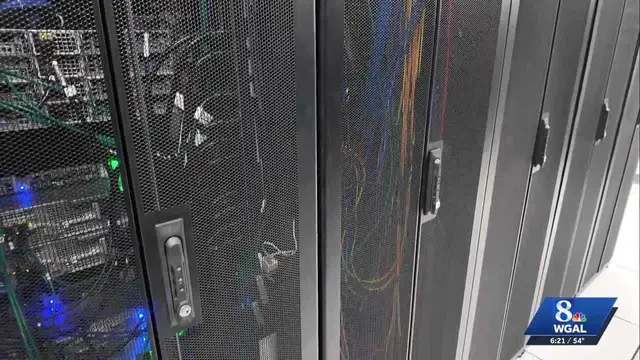
Harrisburg data center offers insight into technology and community concerns Updated: 12:12 PM EST Nov 14, 2026 Editorial Standards ⓘ Maegan Summers Reporter Harrisburg data center offers insight into technology and community concerns Updated: 12:12 PM EST Nov 14, 2026 Editorial Standards ⓘ Maegan Summers Reporter DAUPHIN COUNTY, Pa.
A Harrisburg data center operated by Alerify provides a closer look at the technology behind the cloud, as concerns grow over the development of larger hyperscale data centers in Pennsylvania.
Video above: Top news stories from News 8 at 5 p.m.
"This data center here isn’t one of those large AI hyperscale data centers. It's actually only 2,500 square feet. And it fits in this commercial building right behind me," said Andy Kochanowski, CEO of Alerify, during a tour of the facility.
Kochanowski explained that customers trust the center with their data and equipment, emphasizing the importance of security.
"Customers trust us with their data and their equipment, and they don’t want anybody, you know, getting into it," Kochanowski said.
Inside the facility, the hum of machines and air conditioning systems is constant.
"That noise, is that all of the machines and everything?" asked News 8's Maegan Summers during the tour.
"That noise is at some of the machines, but mainly it's the air conditioning systems to keep the equipment cool," Kochanowski said.
The center houses computer servers and data storage rented by various customers, essentially serving as the physical form of the cloud.
"It's almost like your personal belongings when you put them in storage. But we're doing it for computer equipment. So that's called co-location," Kochanowski said.
"Virtual server hosting is basically, instead of owning equipment, you want to create a private server up in the cloud. This is the cloud," he added.
The facility operates at about 50% capacity, with aisles of equipment rotated between hot and cold zones to regulate temperatures.
"It's comfortable in here. It’s probably like 71 or 69. Yeah. So it's reasonable. But if you come in here, it’s probably going to feel like a temperature difference," Kochanowski said.
Between cooling the building and powering the machines, the data center uses 40,000 to 80,000 kilowatt-hours of electricity per month. Despite its relatively small size — about 2,500 square feet, comparable to a tennis court — larger hyperscale data centers can span hundreds of thousands of square feet.
One such center being built in Lancaster is 850 times larger than the Harrisburg facility.
"We've seen more of these hyperscale data centers start to come up. Do you think that they're necessary?" Summers asked.
"They need to go somewhere. You know, obviously I'm a consumer. I have a home. I don't want to see my electric rates go up either. And I don't want to deal with the noise. But they do need to go somewhere," Kochanowski said.
The rapid development of hyperscale data centers has sparked concerns among community groups like Lancaster Stands Up. Taylor Enterline, a member of the group, outlined their worries about the environmental and community impact.
"The electric grid. What happens when there's a blackout? If there's a blackout, the data center is going to keep running. They have all these backup generators. But where does the help come from? For our neighbors, our biggest one is water. Our beautiful Susquehanna, down the road, is sacred. It's beautiful. How are we protecting our water?" Enterline said.
Enterline suggested state-level regulations on hyperscale data centers and artificial intelligence, as well as community benefit agreements to hold developers accountable.
"Testing and control. Right. We're not just like testing beforehand. We're testing during and we're testing afterwards. And if they are not following through on that, who is holding them accountable? Who knows if these large, you know, monstrosities of AI hyperscale data centers are going to be needed in five to 10 years? Who's responsible for shutting those down, cleaning them up? It should not be on the community who didn’t want them in the first place," Enterline said.
As a smaller data center owner, Kochanowski shared his perspective on environmentally friendly practices, including partnering with Penn State students to develop more efficient air conditioning systems.
"There are a lot of dilapidated, old foundries and steel mills that already have the power into those places but are just barren. We have to redo something like that versus starting brand new. We also need to be very conscientious of the noise, especially in communities. And the power draw, you know, to the extent they can produce their own power, that's great," Kochanowski said.
He also highlighted the benefits of closed-loop cooling systems for water conservation.
"I think that’s the best way to go, honestly. I mean, to the extent you can recirculate that water through that computer equipment and not have to continue to tap the challenges making that water cool itself down before it cycles back through," Kochanowski said.
Looking ahead, Kochanowski predicted continued growth in the data center industry but noted that advancements in equipment could reduce the need for large facilities.
"I think it's going to continue to grow. The question becomes whether or not the equipment needed shrinks. Then it may not be as big an issue in the future as what it is today," Kochanowski said.
Charted: Here's how FAA ground stop compares to other flight cancellations, delays this year Microsoft says services are now fully restored after global outage Wild video shows the moment a tanker struck a docked cruise ship in New Orleans Interactive graphic shows the dramatic impact of Friday's FAA ground stop
Harrisburg, Pennsylvania
Technology
Saturday, November 14, 2026
4 min
By David Robinson

By David Robinson

By Sarah Patel

By Eliot Chen